

Valencia vs. Medellín: A Cost of Living Comparison for Digital Nomads
Valencia or Medellín? Discover which global hub wins the cost-of-living battle for digital nomads in 2026. From high-end real estate in El Poblado to Mediterranean lifestyle in Spain, we break down housing, healthcare, and visa requirements for remote professionals.
LIVING & REAL ESTATE
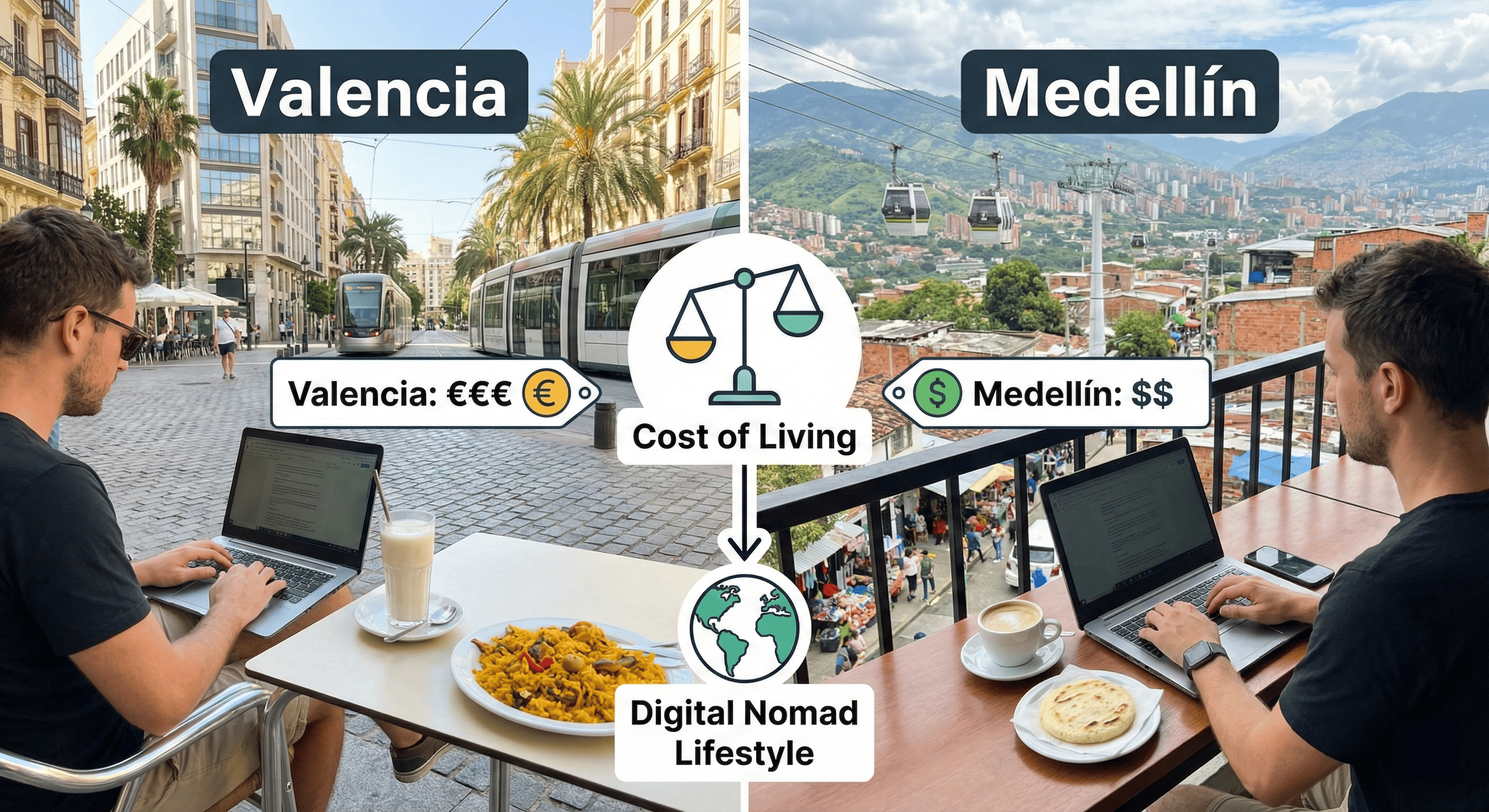
Valencia, Spain, and Medellín, Colombia, have emerged as two of the most popular global hubs for remote workers in 2026. While they are located on different continents, they are frequently compared by digital nomads seeking a balance between lifestyle quality and financial efficiency. Valencia offers a Mediterranean European lifestyle with high-tier infrastructure, while Medellín provides a vibrant, high-energy atmosphere with a significantly lower entry point for daily expenses. This comparison provides a detailed, breakdown of the cost of living Valencia vs Medellín to help remote professionals decide which destination best aligns with their budget and personal goals.
What Does Cost of Living Mean for Digital Nomads?
For a digital nomad, "cost of living" is a broader metric than it is for a permanent resident. It is not just about the price of milk or electricity; it is a calculation of the "lifestyle price tag" required to maintain a productive remote work environment.
A comprehensive nomad budget typically includes:
Housing & Connectivity: Short-to-medium-term furnished rentals and high-speed fiber internet.
Lifestyle & Socializing: Dining out, specialty coffee, and networking events.
Mobility: Access to public transit, ride-sharing, or bike-sharing systems.
Healthcare: International health insurance or local private medical access.
Administrative Costs: Visa fees, local taxes, and coworking memberships.
When evaluating digital nomad cost of living, the goal is often to achieve "geographic arbitrage"—earning in a stronger currency (like USD or EUR) while spending in a location where that income has higher purchasing power.
Housing Costs in Valencia vs. Medellín
Housing is consistently the largest expense for any remote worker. In 2026, both cities have seen rental price increases due to high demand, but the market structures remain distinct.
Valencia: The European Premium
In Valencia, the rental market is split between long-term leases and "seasonal" nomad-friendly apartments.
Neighborhoods: Digital nomads favor Ruzafa (trendy, central), El Cabanyal (near the beach), and Benimaclet (young, bohemian).
Standard Costs: A modern one-bedroom apartment in a central area typically ranges from €1,100 to €1,600 per month.
Short-term: Furnished monthly rentals on platforms like Flatio or Airbnb often command a 20–30% premium, frequently reaching €1,800–€2,200 during peak spring and fall seasons.
Medellín: High-End Value
Medellín’s housing market is defined by "estratos" (socioeconomic scales), with nomads almost exclusively staying in Estrato 5 or 6 areas.
Neighborhoods: El Poblado is the primary hub, though Laureles and Envigado are increasingly popular for those seeking a more traditional "barrio" feel.
Standard Costs: In El Poblado, a high-end furnished studio or one-bedroom typically costs between $1,100 and $1,600 USD.
Local Market: For those willing to sign 6-month leases in Laureles, prices can drop significantly to $700–$900 USD.
Verdict: While top-tier apartments in Medellín are approaching European prices, Valencia remains more expensive for "middle-of-the-road" housing.
Daily Expenses and Lifestyle Costs
Day-to-day spending is where the Medellín cost of living provides its greatest advantage, particularly regarding labor-intensive services and local produce.
Food and Groceries
Valencia: Groceries for a single person average €250–€350 per month. While supermarkets like Mercadona are affordable, the local Mercado Central offers high-quality fresh goods at competitive prices.
Medellín: Local groceries are significantly cheaper, often totaling $150–$250 USD per month. However, imported items (European cheeses, specific electronics) can be more expensive than in Spain.
Dining and Socializing
Dining Out: Valencia’s Menú del Día (three-course lunch) is a staple at €12–€16. A mid-range dinner for two is roughly €50–€70.
Medellín: A traditional Almuerzo Ejecutivo (lunch special) costs only $5–$8 USD. Even in upscale Poblado restaurants, a high-end dinner rarely exceeds $30–$40 USD per person.
Transportation
Valencia: Extremely walkable and bike-friendly. A monthly metro/bus pass costs approximately €35–€45. The Valenbisi bike-share is roughly €30 annually.
Medellín: Nomads rely heavily on the Metro de Medellín (clean and efficient) and ride-sharing apps like Uber or InDrive. Taxis and Ubers are very inexpensive, with most cross-city trips costing under $6 USD.
Healthcare and Insurance
Accessing quality medical care is a priority for long-term nomads. Both cities offer excellent private facilities, but the systems and costs differ significantly.
System Type & Quality:
Valencia: Operates on a Universal Public + Private system with world-class facilities meeting high EU standards.
Medellín: Uses an EPS (Public-ish) system alongside private options. It is recognized as a top-tier medical tourism hub in Latin America.
Private Insurance Costs:
Valencia: A comprehensive private plan typically ranges from €60–€100 per month.
Medellín: Comparable private coverage generally costs between $50–$90 USD per month.
Visa Requirements: It is crucial to note that mandatory private health insurance is usually required for both the Spanish Digital Nomad Visa and most long-stay Colombian visas. In Valencia, private insurance (like Sanitas or Adeslas) often provides zero-copay access to specialists. In Medellín, private clinics like Fundación Valle del Lili provide care that rivals North American standards at a fraction of the price.
Taxes, Visas, and Practical Considerations
The ease of legal residency is a major factor in the living in Spain vs Colombia debate.
Spain Digital Nomad Visa (DNV)
Income Requirement: Applicants must earn roughly €3,000+ per month (200% of the Spanish minimum wage).
Taxes: Under the "Beckham Law," eligible nomads can apply for a flat 24% tax rate on Spanish-sourced income up to €600,000 for up to six years.
Benefit: Provides a path to permanent residency and eventual citizenship, plus visa-free travel within the Schengen Area.
Colombia Digital Nomad Visa (V-Visa)
Income Requirement: Much lower than Spain, typically requiring $1,100–$1,300 USD per month (3x the Colombian minimum wage).
Taxes: Generally, if you spend more than 183 days in Colombia, you become a tax resident. However, enforcement for remote workers is currently less stringent than in the EU.
Benefit: Extremely easy and fast application process, though it does not typically lead to permanent residency as directly as the Spanish DNV.
Quality of Life for Digital Nomads
Climate and Safety
Valencia: 300+ days of sun. Summers are very hot (35°C+), and winters are mild. It is one of the safest cities in Europe, allowing for high mobility at all hours.
Medellín: Known as the "City of Eternal Spring," the temperature stays around 22–26°C year-round. Safety has improved, but "situational awareness" is still required, especially at night and outside major nomad zones.
Infrastructure and Coworking
Valencia: Robust public infrastructure, high-speed rail (AVE) to Madrid/Barcelona, and very stable internet (600Mbps–1Gbps fiber).
Medellín: World-class coworking spaces (like Selina or Semilla) and a highly resilient community. However, power outages or internet fluctuations can occasionally occur during heavy tropical storms.
Valencia vs. Medellín — Key Differences at a Glance
Cost: Medellín is roughly 30–45% cheaper overall than Valencia for a comparable nomad lifestyle.
Walkability: Valencia is superior for walking and cycling; Medellín requires more reliance on vehicles.
Safety: Valencia has a significantly lower crime rate and a higher sense of public safety.
Culture: Valencia offers a laid-back, "siesta and fiesta" Mediterranean vibe; Medellín offers a high-energy, entrepreneurial, and salsa-centric Latin culture.
Time Zone: Medellín is ideal for those working with US-based clients (EST/CST), while Valencia is better for EMEA-based work.
Key Takeaways for Digital Nomads
Budgeting: Expect to spend at least €2,200/month for a comfortable life in Valencia vs. $1,400/month in Medellín.
Visa Ease: Colombia has a lower financial barrier to entry, but Spain offers more long-term European residency benefits.
Environment: Choose Valencia for safety and stability; choose Medellín for climate and social energy.
Internet: Both cities offer excellent connectivity suitable for high-bandwidth video calls and developer workflows.
Frequently Asked Questions
Is Medellín cheaper than Valencia? Yes, overall Medellín is approximately 30-45% less expensive. The most significant savings are found in dining, transport, and local services.
Which city has better internet for remote work? Both are excellent. Valencia has a more mature fiber-optic network nationwide, but Medellín's coworking hubs offer top-tier speeds (up to 500Mbps) reliable for any digital nomad.
Can I live in Valencia or Medellín on $1,500 a month? In Medellín, $1,500 allows for a very comfortable, mid-to-high-end lifestyle. In Valencia, $1,500 (approx. €1,400) would be considered a tight budget, likely requiring shared housing or living in the outer suburbs.
Further Resources
[Check our Guide to International Relocation Services]
[Read our Insight Article on the Best Digital Nomad Visas for 2026]